info@empircoreandlegacy
--Protect What Matters Most--
347-622-4994

Long-Term Care Insurance
Protect Your Independence. Protect Your Savings. Protect Your Legacy.
As we plan for retirement and the future, many people focus on life insurance and building savings.
But there is another important question to consider:
What Happens If You Need Help Taking Care of Yourself?
A long-term illness, disability, injury, or cognitive condition could make it difficult to perform everyday activities independently.
At Empire Core & Legacy, we help individuals and families understand and explore long-term care insurance options designed to help prepare for the potential need for extended care.
Planning for Care Is Also Planning for Your Family.
Long-term care refers to services and support that may be needed when someone has difficulty performing everyday activities or requires ongoing supervision.
Depending on your needs, long-term care may be received in different settings, including:
•Your own home
•An assisted living facility
•A nursing home
•An adult day care setting
•Other eligible care settings
The type of care you need and the services covered depend on your individual circumstances and the specific insurance policy.
What Is Long-Term Care Insurance?
Long-term care insurance is designed to help provide benefits for qualifying long-term care services.
Benefits and eligibility are based on the terms of the policy.
Depending on the policy, benefits may help pay for eligible services such as:
•In-home care
•Assisted living
•Nursing home care
•Adult day care
•Care coordination
•Other qualifying long-term care services
Some policies may also include additional features or optional benefits.
Why Consider Long-Term Care Planning?
Many people assume that long-term care is only something older adults need to think about.
However, the need for care can arise due to:
•Aging
•A serious illness
•An injury
•A disability
•Cognitive impairment
•A chronic medical condition
The question is not only:
“Who Will Take Care of Me?”
It's also:
“How Will We Pay for the Care I Need?”
Without a plan, the responsibility may fall on your spouse, children, family members, or personal savings.
Long-term care planning may help you prepare for that possibility.
Long-Term Care May Help You:
🏡 Stay in Your Home
Depending on your policy and eligibility, benefits may help pay for qualifying care and services that allow you to receive assistance in your home.
❤️ Reduce the Burden on Loved Ones
Family members often step in to provide care when someone can no longer live independently.
Having a plan may help reduce some of the financial and caregiving responsibilities placed on loved ones.
💰 Help Protect Your Savings
Extended care can create significant expenses over time.
Long-term care insurance may help provide benefits for qualifying services so that you may not have to rely entirely on personal savings and other assets.
🛡️ Give You More Choices
Having financial resources available for care may give you more flexibility when deciding where and how you receive qualifying long-term care services.
What Are Activities of Daily Living?
Many long-term care insurance policies use Activities of Daily Living (ADLs) when determining whether someone qualifies for benefits.
These activities generally include:
•Bathing
•Dressing
•Eating
•Toileting
•Transferring
•Continence
Depending on the policy, benefits may become available when you are unable to perform a specified number of Activities of Daily Living without substantial assistance or when you have a qualifying cognitive impairment.
Eligibility requirements vary by policy.
What Is Cognitive Impairment?
Cognitive impairment refers to a decline in mental ability that may affect a person's memory, reasoning, judgment, orientation, or ability to safely function independently.
Depending on the policy terms, a qualifying cognitive impairment may allow an insured person to meet the eligibility requirements for long-term care benefits.
Health insurance and long-term care insurance serve different purposes.
It is important to understand what your current health coverage does and does not cover when planning for future care needs.
Could Long-Term Care Insurance Be Right for You?
Long-term care planning may be worth exploring if you:
•Want to prepare for potential future care needs
•Want to help protect your retirement savings
•Do not want your children or family members to carry the full responsibility of your care
•Want more choices regarding where you receive care
•Own assets you would like to help preserve
•Are planning for retirement
•Have a family history that makes you concerned about future care needs
•Want to explore life insurance policies with qualifying long-term care or chronic illness benefits
Questions to Ask Yourself
❓ If I needed daily assistance, who would take care of me?
❓ Would my spouse or children have to stop working to provide care?
❓ Could I afford extended care using my personal savings?
❓ Do I know what my current health insurance would cover?
❓ Would I prefer to receive care at home if possible?
❓ How would long-term care expenses affect my retirement plans?
❓ Do I want to leave assets or a financial legacy for my family?
If these questions make you stop and think, now may be a good time to start exploring your options.
What We'll Discuss During Your Consultation
During your long-term care consultation, we'll discuss your concerns, goals, and the types of protection you may want to explore.
We may discuss:
•Your current age and future plans
•Your retirement goals
•Existing insurance coverage
•Your concerns about future care
•Your budget
•Your desire to protect savings and assets
•Your preferred type of care
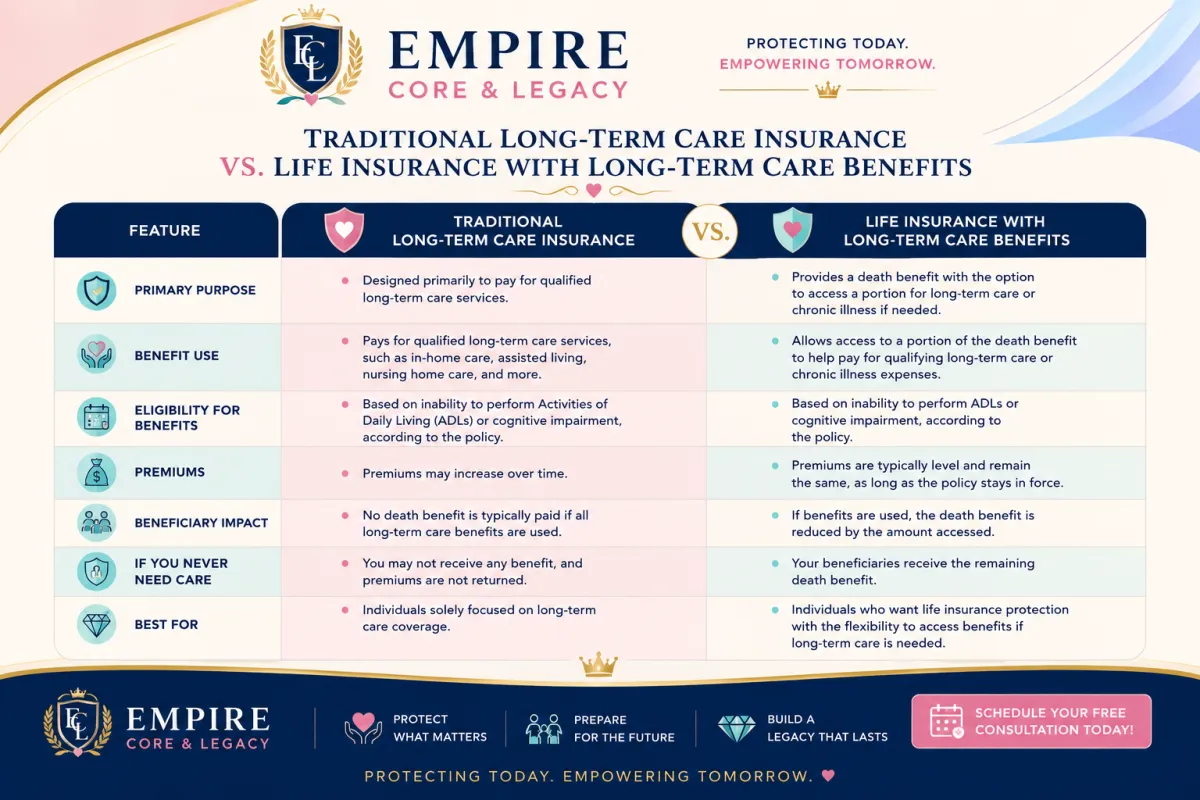
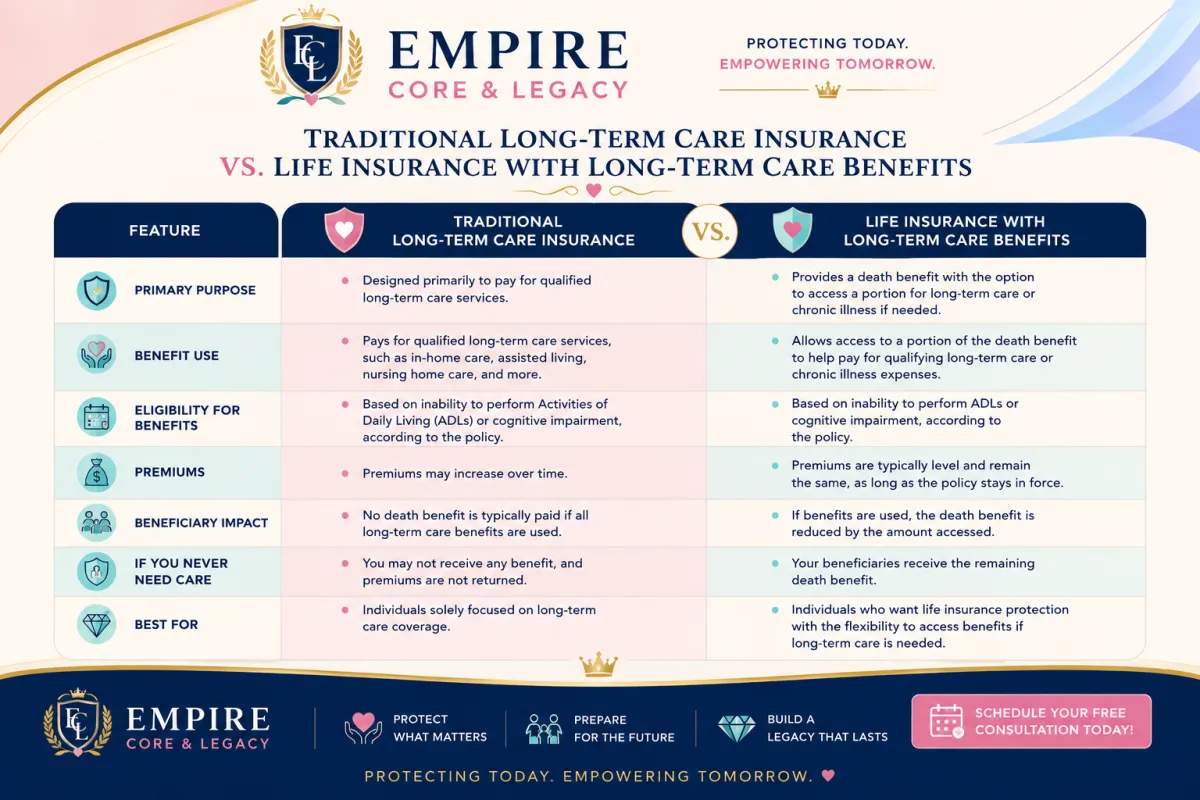
•Traditional long-term care insurance options
•Life insurance options that may include qualifying long-term care or chronic illness benefits
The Goal Is to Help You Understand Your Options Before You Need Them.
Frequently Asked Questions
Does Medicare pay for long-term care?
Medicare coverage for long-term care is limited and generally does not cover most long-term custodial care. Coverage depends on the type of service and the individual's eligibility.
Does health insurance cover long-term care?
Traditional health insurance is generally designed to cover medical treatment and may not cover ongoing custodial care or assistance with everyday activities. Coverage varies by plan.
When should I consider long-term care insurance?
The right time depends on your age, health, financial situation, retirement plans, and the availability and affordability of coverage. Applying while you are younger and healthier may provide more options, depending on the insurer and underwriting requirements.
Can I receive long-term care in my home?
Depending on the policy and eligibility requirements, benefits may be available for qualifying home-based care services.
What happens if I never need long-term care?
The answer depends on the type of policy you choose. Traditional long-term care insurance and life insurance policies with long-term care or chronic illness benefits operate differently. A licensed insurance professional can help explain the available options.